

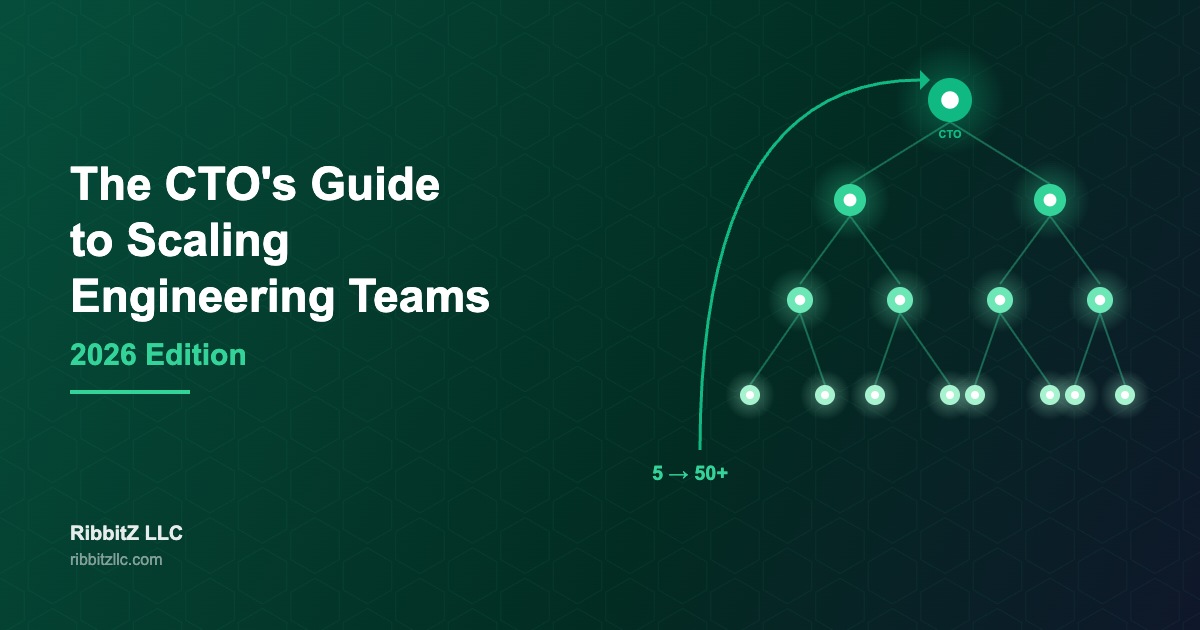
The Scaling Challenge
Growing an engineering team from five developers to fifty is one of the hardest operational challenges in technology. The processes, communication patterns, and management structures that work at five people break down completely at twenty. What works at twenty fails at fifty. Every growth stage requires deliberate reinvention of how your team operates.
Most CTOs learn this the hard way — through missed deadlines, cultural erosion, and talented engineers leaving because the company “changed.” This guide maps out the inflection points, the decisions that matter at each stage, and the frameworks that make scaling predictable instead of chaotic.
Stage 1: The Founding Team (1-5 Engineers)
At this stage, communication is effortless because everyone sits in the same room or the same Slack channel. Architecture decisions happen through informal conversation. Code quality depends on individual discipline. There is no need for formal processes because the overhead of process exceeds the benefit.
What to get right now:
- Establish coding standards and a code review culture before you need them. It is infinitely easier to maintain standards than to introduce them later.
- Set up CI/CD from day one. Automated testing and deployment become non-negotiable at scale.
- Document architectural decisions. Future team members will need to understand why choices were made, not just what was built.
- Choose a tech stack you can hire for. Exotic technologies impress nobody when you cannot find engineers who know them.
Stage 2: The First Team Split (6-12 Engineers)
This is the first painful transition. The single-team model stops working around six to eight people. Standups take too long. Pull requests sit in review queues. Engineers step on each other’s code. The sense of shared ownership that defined the founding team begins to dissolve.
Key decisions at this stage:
Split into focused squads. Organize around product areas or services, not functions. A squad that owns user authentication end-to-end will outperform a “frontend team” and “backend team” that must coordinate on every feature.
Hire your first engineering manager. The CTO cannot effectively manage twelve individual contributors while also setting technical direction, maintaining architecture, and contributing to business strategy. Promoting a senior engineer or hiring an experienced EM is essential.
Formalize your hiring process. Ad hoc interviewing produces inconsistent results and creates bias. Establish structured interview loops with defined evaluation criteria and calibrated scorecards.
Stage 3: Multi-Team Coordination (13-25 Engineers)
At this stage, no single person understands the entire codebase. Dependencies between teams become the primary source of delays. The engineering organization needs its own internal communication infrastructure.
Critical investments:
API contracts between services. Teams that share a monolith fight over code ownership and deployment timing. Well-defined APIs let teams move independently. This does not necessarily mean microservices — a well-structured modular monolith works too — but boundaries must be explicit.
Technical Program Management. Cross-team projects need someone tracking dependencies, identifying risks, and coordinating timelines. This can be a dedicated TPM or an engineering manager with strong organizational skills.
Staff augmentation for surge capacity. At this stage, your hiring pipeline cannot keep up with growth spurts. Augmenting with external engineers lets you scale capacity for specific initiatives without over-hiring permanent staff.
On-call and incident response. With multiple teams and services, production incidents need structured response processes. Establish clear escalation paths, runbooks, and post-incident review practices before your first major outage.
Stage 4: The Organization (26-50 Engineers)
Engineering is now a department, not a team. Culture can no longer be maintained through proximity — it must be actively cultivated. The CTO’s role shifts from technical leadership to organizational leadership.
What changes:
Engineering leadership team. You need directors or senior managers running sub-organizations. The CTO manages the leadership team, not individual engineers. If the CTO is still reviewing pull requests regularly at this stage, something is structurally wrong.
Career ladders and levels. Engineers need visible growth paths. Without defined levels (IC1 through IC6, or equivalent), promotion decisions become political and your best people leave for companies with clearer progression.
Developer experience investment. Internal tooling, documentation, and platform engineering become force multipliers. A developer experience team that reduces onboarding time from four weeks to one week effectively gives you 12 additional engineering weeks per year for every new hire.
Architecture review process. With multiple teams making technical decisions independently, you need lightweight governance to prevent architectural drift. An Architecture Decision Record system and periodic review sessions keep teams aligned without creating bottlenecks.
Scaling Mistakes That Kill Teams
Hiring too fast. Growing headcount faster than your ability to onboard and integrate new engineers produces negative returns. Each unproductive new hire consumes existing engineers’ time through questions, code reviews, and mentoring. Growth rate should match onboarding capacity.
Promoting every senior engineer to management. Technical leadership and people management are different skills. Creating a strong IC (Individual Contributor) track that reaches principal or staff engineer level lets your best technologists grow without forcing them into management roles they may not want or suit.
Ignoring culture during growth. The cultural norms that existed when you were five people will not survive to fifty unless you deliberately preserve and evolve them. Document your engineering values, hire for cultural alignment, and address cultural issues immediately.
Under-investing in infrastructure. When the team doubles but the CI pipeline, staging environments, and deployment tooling remain the same, everything slows down. Infrastructure investment should lead headcount growth, not follow it.
The Augmentation Advantage at Scale
Smart CTOs use staff augmentation strategically throughout the scaling journey. In early stages, augmented engineers fill specific skill gaps — the ML specialist or DevOps expert you need for six months but not permanently. In growth stages, augmentation provides surge capacity for major initiatives without distorting your permanent headcount plan.
The key is treating augmented staff as full team members with the same access, expectations, and integration as permanent hires. Companies that create a two-tier system — insiders versus outsiders — get two-tier results.
Start Scaling Deliberately
Scaling an engineering team is not about adding headcount. It is about building an organization that maintains quality, speed, and culture as it grows. Every stage requires different structures, processes, and leadership approaches.
The CTOs who scale successfully are the ones who anticipate the next inflection point and prepare for it before the current model breaks.
Need to scale your engineering team quickly without compromising quality? RibbitZ LLC provides staff augmentation services that integrate seamlessly with your existing team. Let’s talk about your growth plan.
Related Articles
- How to Hire Remote Developers: A Step-by-Step Guide for 2026
- How to Reduce Software Development Costs Without Sacrificing Quality
- How to Choose the Right Software Development Partner