

The Cost Problem Every Tech Leader Faces
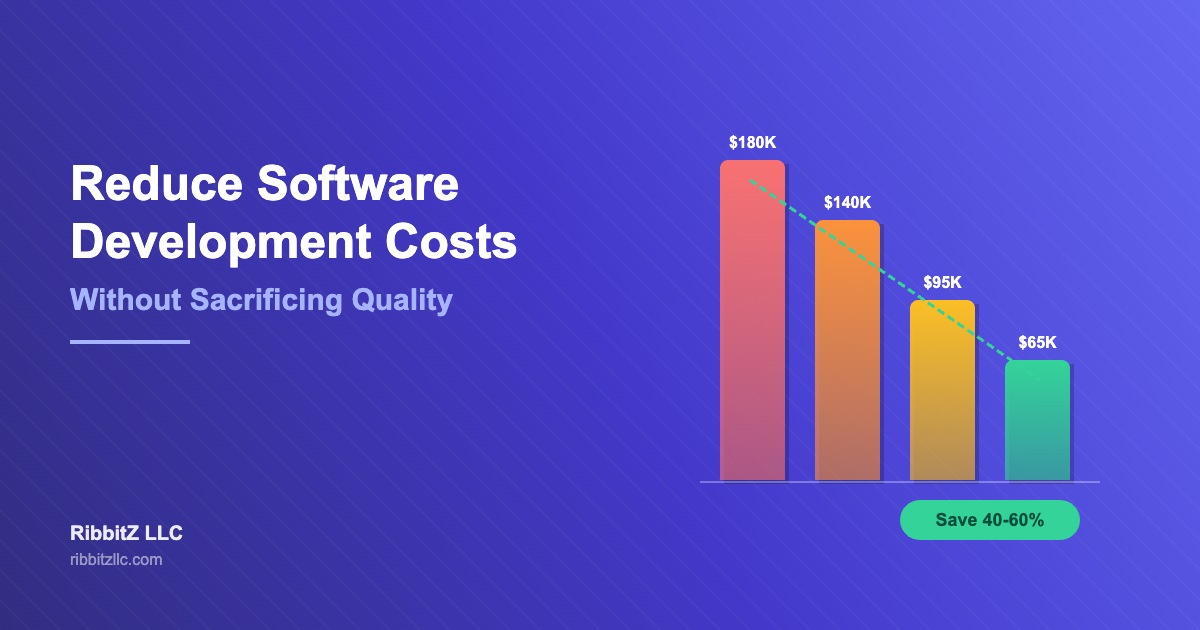
Software development is expensive. The average fully loaded cost of a senior developer in the United States exceeds $180,000 per year when you factor in salary, benefits, equipment, office space, and management overhead. For startups burning through runway and mid-market companies watching margins, the question is always the same: how do we build great software without bankrupting the company?
The bad news is that most cost-cutting approaches destroy the very quality that makes software valuable. The good news is that several proven strategies reduce costs substantially while maintaining — or even improving — quality. Here are the ones that actually work.
1. Use Staff Augmentation Instead of Full-Time Hiring
The biggest cost driver in software development is not technology. It is people. And the most expensive way to scale a team is through direct full-time hiring in high-cost markets.
Staff augmentation lets you add skilled engineers at 40 to 60 percent lower cost by tapping global talent pools. A senior React developer in Eastern Europe or Latin America commands $35 to $65 per hour compared to $85 to $150 per hour for equivalent talent in San Francisco or New York. You get the same code quality without the overhead of benefits, office space, and long-term employment commitments.
The savings are significant. A team of four augmented engineers can save $300,000 to $500,000 annually compared to US-based full-time equivalents, with no degradation in output quality.
2. Invest in Architecture Before Writing Code
Poor architecture is the most expensive mistake in software development because it compounds over time. Every feature built on a weak foundation costs more than it should. Every change risks breaking something else. Technical debt accumulates quietly until it becomes a crisis.
Spending two weeks on architecture planning before a project starts can save months of rework later. This means defining clear service boundaries, choosing the right data models, establishing API contracts, and documenting key design decisions before the first line of production code is written.
The teams that skip this step to “move faster” invariably spend more total engineering hours than the teams that plan first.
3. Automate Testing Early
Manual QA testing is slow, expensive, and error-prone. A manual regression test cycle that takes two QA engineers three days each sprint represents over 500 hours per year — roughly $50,000 to $75,000 in labor costs, plus the opportunity cost of delayed releases.
Automated test suites run in minutes, catch regressions instantly, and free QA engineers to focus on exploratory testing where humans add irreplaceable value. The upfront investment in test automation pays for itself within two to three sprints for most teams.
Focus automation on the highest-value areas first: API integration tests, critical user flows, and data validation. Unit tests are important but integration and end-to-end tests catch the bugs that actually cost money in production.
4. Reduce Scope Ruthlessly
The most cost-effective feature is the one you do not build. Every product has features that seem important during planning but deliver minimal user value. Identifying and cutting these features before development starts is the highest-leverage cost reduction available to any team.
Use data-driven prioritization frameworks. Measure each feature against customer demand, revenue impact, and development effort. Features that score low on demand and revenue but high on effort should be questioned, deferred, or eliminated entirely.
Many successful companies ship with 30 to 40 percent fewer features than originally planned and find that customers never notice what was cut.
5. Standardize Your Tech Stack
Every additional programming language, framework, or database in your stack multiplies costs. More technologies mean more specialized hiring, more training, more security patches, more infrastructure complexity, and more context switching for developers.
Standardizing on a focused tech stack — one primary backend language, one frontend framework, one database engine — reduces costs across the board. Engineers become more proficient, code reviews are more effective, and onboarding new team members takes days instead of weeks.
This does not mean using the wrong tool for every job. It means having a strong default stack and requiring explicit justification for deviations.
6. Implement CI/CD Properly
Manual deployment processes are expensive in ways that do not show up on a balance sheet. They consume senior engineer time, introduce human error, delay releases, and create bottlenecks that slow the entire team.
A proper CI/CD pipeline automates building, testing, and deploying code. Once established, deployments that previously took hours of careful manual work happen in minutes with a button click. Teams that deploy multiple times per day find and fix bugs faster, ship features sooner, and spend less engineering time on deployment-related overhead.
7. Use Code Reviews as a Cost-Saving Tool
Code reviews are often seen as a quality practice, but they are equally important as a cost reduction strategy. Bugs caught in code review cost roughly ten times less to fix than bugs caught in QA, and one hundred times less than bugs discovered in production.
Beyond catching bugs, code reviews prevent knowledge silos. When only one engineer understands a critical system, that engineer becomes a bottleneck and a single point of failure. Code reviews distribute knowledge across the team, reducing the cost and risk of turnover.
8. Measure and Optimize Developer Productivity
You cannot reduce costs if you do not know where time is being spent. Track key engineering metrics: cycle time from commit to deployment, time spent on bug fixes versus new features, pull request review turnaround, and sprint velocity trends.
Teams that measure these metrics consistently find surprising inefficiencies. Common discoveries include excessive meeting load consuming 30 percent of engineering time, unclear requirements causing multiple rework cycles, and slow CI pipelines adding 20 to 30 minutes of wait time per developer per day.
Each of these inefficiencies represents recoverable cost once identified.
The Bottom Line
Reducing software development costs is not about paying people less or cutting corners. It is about eliminating waste, making smart structural decisions, and leveraging global talent efficiently. Companies that implement these strategies typically reduce total development costs by 30 to 50 percent while improving both quality and speed.
Looking to reduce development costs through staff augmentation? RibbitZ LLC connects you with vetted engineers at competitive global rates. Request a consultation to explore your options.
Related Articles
- How to Hire Remote Developers: A Step-by-Step Guide for 2026
- The CTO’s Guide to Scaling Engineering Teams in 2026
- How to Choose the Right Software Development Partner